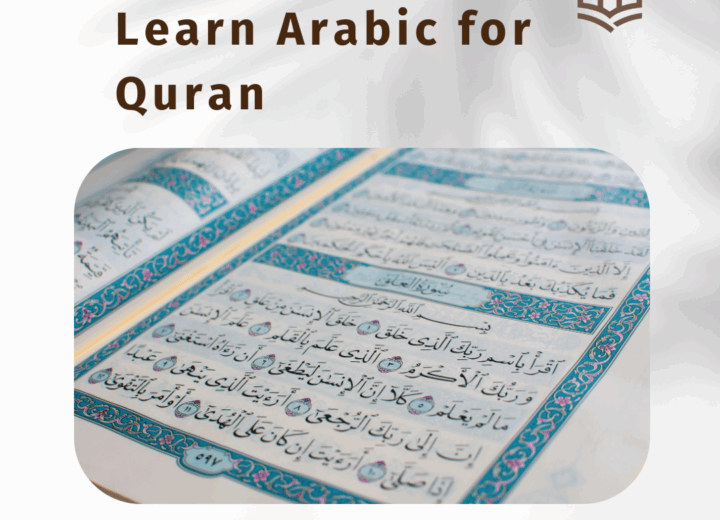
The Quran is the divine word of Allah ﷻ, revealed to guide humanity. Reading it with care, respect, and accuracy is a responsibility for every Muslim. This is where the rules of Tajweed become essential. Tajweed is not just about correct pronunciation, but also about honoring the words of Allah by reciting them as they were revealed to the Prophet ﷺ.
Allah ﷻ says in the Quran: (عَلَيْهِ وَرَتِّلِ ٱلْقُرْءَانَ تَرْتِيلًا)
(and recite the Quran ˹properly˺ in a measured way.) Surah Al-Muzzammil 73:4
This verse highlights the importance of reciting the Quran slowly and carefully, which is the essence of Tajweed.
What is Tajweed?
The word Tajweed comes from the Arabic root “j-w-d” (ج-و-د), meaning “to make better” or “to improve.” In Quranic recitation, it refers to giving every letter its right by pronouncing it correctly from its articulation point (makhraj) and applying the proper characteristics (sifaat).
Without Tajweed, the meaning of words can change. For example, a small mistake in elongation or articulation could alter the meaning of a verse, which is why learning the rules of Tajweed is crucial for every reciter.
Why are the Rules of Tajweed Important?
- Preservation of the Quran: Tajweed protects the authenticity of the Quran as revealed.
- Respect for Allah’s Words: Reading with Tajweed shows reverence and care.
- Avoiding Mistakes: Tajweed prevents errors that may change meanings.
- Spiritual Impact: Reciting with Tajweed brings beauty and khushu’ (humility) to the heart.
قَالَ رَسُولُ اللَّهِ ـ صلى الله عليه وسلم ـ “ زَيِّنُوا الْقُرْآنَ بِأَصْوَاتِكُمْ ” .
The Messenger of Allah (ﷺ) said: “Beautify the Qur’an with your voices.” (Sahih al-Bukhari, Sahih Muslim)
This hadith encourages Muslims to recite in a clear and melodious way, which is only possible by applying Tajweed rules.
Main Rules of Tajweed
- Makharij al-Huroof (Articulation Points)
Every letter in Arabic has a specific point of origin in the mouth, throat, or lips. Learning these articulation points ensures correct pronunciation, especially between letters that sound similar, like ص (Saad) and س (Seen). - Sifaat al-Huroof (Characteristics of Letters)
Each letter has unique qualities, such as heaviness (tafkhim) or lightness (tarqeeq). For example, the letter ر (Ra) can be heavy or light depending on its position and the vowels around it. - Noon Saakin and Tanween Rules
– Idgham: Merging sounds.
– Ikhfaa: Concealing sound.
– Ith-haar: Clear pronunciation.
– Iqlab: Changing noon sound into meem with ghunnah (nasalization). - Meem Saakin Rules
– Ikhfaa Shafawi
– Idgham Shafawi
– Ith-haar Shafawi
These rules are applied when the letter م (meem) is followed by different letters. - Madd (Prolongation)
Madd means extending the sound of a letter. For example, when a vowel is followed by certain letters like hamzah (ء) or sukoon, the sound must be prolonged by 2, 4, or 6 counts depending on the type of Madd. - Qalqalah
Qalqalah refers to a slight echoing sound produced when pronouncing certain letters (ق، ط، ب، ج، د) in a state of sukoon. This makes the recitation clearer and more beautiful.
How to Learn the Rules of Tajweed Effectively
- Start with the Basics: Learn Arabic letters and their sounds first.
- Practice Regularly: Tajweed requires repetition and listening.
- Learn with a Teacher: The Prophet ﷺ himself taught the Quran directly to his companions, showing the importance of oral transmission.
- Use Audio Resources: Listening to skilled reciters helps reinforce proper application.
- Take Online Courses: Structured rules of Tajweed courses provide step-by-step guidance.
Common Mistakes in Tajweed
- Mixing up heavy and light letters.
- Ignoring elongation (Madd).
- Overlooking nasal sounds (ghunnah).
- Reading too quickly without measured recitation.
Avoiding these mistakes requires patience, consistency, and guidance.
Quranic Inspiration
The Quran itself emphasizes ease in learning: “And We have certainly made the Quran easy for remembrance, so is there any who will remember?” (Surah Al-Qamar 54:17)
فال تعالي :(وَلَقَدْ يَسَّرْنَا ٱلْقُرْءَانَ لِلذِّكْرِ فَهَلْ مِن مُّدَّكِرٍۢ)
This shows that Tajweed is not meant to be a burden but a path to reciting the Quran correctly and beautifully.
Conclusion
Mastering the rules of Tajweed is a journey that requires dedication but brings immense reward. By applying Tajweed, you not only protect the Quran’s meanings but also bring tranquility to your heart through every verse you recite.
Ready to improve your recitation?
Join our specialized Tajweed courses online with certified teachers and learn step by step how to apply every rule correctly. book your free trial today and let the Quran illuminate your life.