Arabic is one of the most beautiful and influential languages in the world, connecting millions of speakers across different countries and cultures. Whether you’re learning it to understand the Qur’an, communicate with native speakers, or explore its rich literature, mastering Arabic can open countless doors. Thanks to the convenience of online Arabic classes, you can now start your journey from anywhere in the world, no matter your schedule or location. In this guide, we’ll share the best tips, essential basics, and recommended resources to help you learn Arabic quickly and effectively, whether you’re starting from scratch or aiming to reach fluency.
How to Learn Arabic from scratch?
- Make sure to embrace and use Arabic at home
Make Arabic the language spoken daily at home as much as possible. - Have full conversations with your children in Arabic
Encourage your kids to speak Arabic by using it consistently during conversations. - Play games in Arabic
Choose fun and educational games that use Arabic words to help build vocabulary. - Use educational tools
Incorporate Arabic books, apps, songs, and videos to support learning. - Immerse them in Arabic culture
Expose children to Arabic traditions, stories, music, and celebrations to deepen their connection with the language. - Celebrate the small things
Praise any progress made, no matter how small, as motivation to continue learning.
What Are the Basics of a Language?
Learning any language, especially Arabic, starts with building a strong foundation.
Here are the core basics of any language:
- The Alphabet
• Learning the letters and how they are written and pronounced.
• In Arabic: learning shapes of letters, short vowels (ḥarakāt), tanwīn, and madd (long vowels). - Pronunciation
• Training your ear to hear and pronounce sounds correctly.
• Arabic includes unique sounds like ع (ʿayn) and ق (qāf) that need special practice. - Vocabulary
• Start with common everyday words: family, numbers, colors, food, etc.
• Build your word bank step by step. - Grammar
• Learn the structure of sentences:
• Nouns, verbs, and particles (in Arabic: اسم، فعل، حرف).
• Sentence types: nominal and verbal sentences.
• Word endings (iʿrāb) in Arabic grammar. - Reading
• Begin with simple texts (children’s stories, short passages).
• Helps in recognizing sentence structure and expanding vocabulary. - Listening
• Listen to the language daily: songs, news, stories, Qur’an recitation (for Arabic).
• It trains your brain to understand naturally. - Speaking
• Practice speaking even simple phrases.
• Don’t be afraid of mistakes, practice leads to fluency. - Writing
• Start writing short sentences.
• Practice forming full thoughts using new vocabulary and grammar. - Consistency
• Study a little every day.
• Repeat and review often.
If you want to build a strong foundation, joining online Arabic classes can be one of the fastest and most effective ways to master the basics. These classes offer structured lessons that cover the alphabet, pronunciation, vocabulary, and grammar, while giving you the opportunity to practice with experienced teachers. Whether your goal is daily communication or to learn Arabic for Quran recitation, starting with the right basics will help you progress confidently.
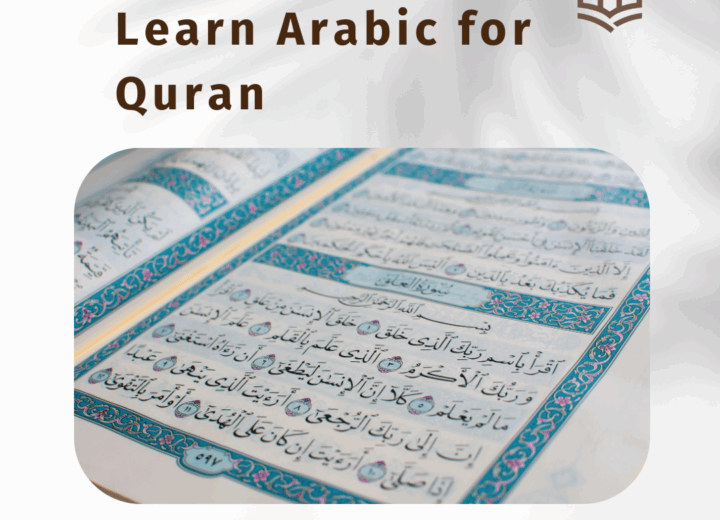
For beginners who wish to learn Arabic for Quran reading, exploring authentic texts like Quran.com can help improve pronunciation and understanding.
Best Books to learn Arabic for beginners
(Noor Al-Bayan)This book is carefully designed to provide a gradual approach to reading for beginners. It starts with the Arabic letters, including their vowel marks (ḥarakāt), tanwīn (nunation), and lengthening (madd), among other basics. The goal is to build a solid foundation so that the learner can eventually read fluently and confidently.
By progressing step by step, the reader develops the ability to read full sentences and paragraphs. The book also includes selected examples from the Holy Qur’an to help refine pronunciation and strengthen the learner’s Arabic tongue.
Note: The book is also suitable for non-Arabic speakers.
How to learn Arabic fluently?
Listen frequently to content in Modern Standard Arabic (MSA), such as Qur’anic recitations, news broadcasts, and educational programs.
• Read a variety of formal Arabic texts, including newspapers, stories, and literary books.
• Study Arabic grammar rules and apply them regularly in writing and speech.
• Engage with native Arabic speakers and practice speaking with them whenever possible.
How to speak in classical Arabic Fluently?
First: Protect yourself from incorrect or distorted Arabic (known as al-lahn) and avoid listening to Fus’ha that is full of mistakes. Purify your ears by only listening to proper, eloquent, and grammatically correct Arabic.
Second: Expose yourself constantly to high-quality, correct Classical Arabic. Immerse yourself in it as much as possible through reading, listening, and practicing.